SpaceX Just Bought the Coding Tool Half of Silicon Valley Depends On
Four days after the largest IPO in history, SpaceX exercised its option to acquire AI startup Corsair for $60 billion in stock. This deal gives Elon Musk's xAI division a million paying developers overnight.
 Nick Bunker
SAN FRANCISCO, United States — June 17, 2026
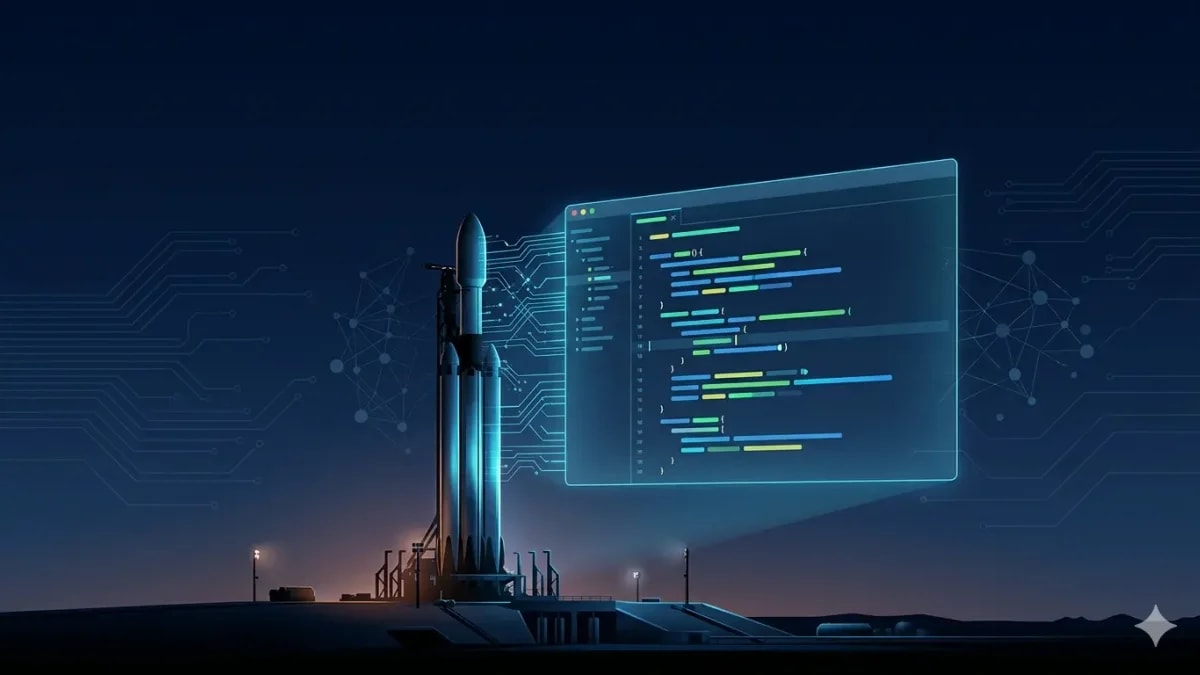
Here is the part of this story that should make every developer using an AI coding assistant pause for a second, regardless of which one: on Tuesday, a rocket company bought the editor.
SpaceX agreed to acquire AI coding startup Cursor in a $60 billion stock deal, just a few days after the space company's historic IPO and less than two months after announcing a tie-up between the two. Wikidata The deal, confirmed through an 8-K regulatory filing, is the largest acquisition of an AI developer-tools company ever recorded. Wikidata If you write code for a living — or, like me, you build production software (job boards, content pipelines, CMS platforms) without a formal engineering team behind you — this is not a Silicon Valley curiosity. It is a supply chain event.
The Option That Became Inevitable
This deal did not appear out of nowhere. Musk's company announced a curious arrangement in April: it would either buy Cursor for $60 billion in stock, or pay a $10 billion break-up fee if the deal fell through. Wikidata That agreement was not idle optionality — Cursor was already training its newest models on xAI's Colossus infrastructure, developing Composer 2.5, its latest in-house frontier coding model. Wikidata Reading the timeline closely, the acquisition was never really a question of "if." It was a question of which trigger would fire first: Cursor's standalone fundraise, or SpaceX's IPO giving it the stock currency to make the move itself.
Before SpaceX came knocking, Cursor was on track to close a $2 billion funding round from Andreessen Horowitz, Thrive, and Nvidia that would have valued the company at $50 billion. Wikidata SpaceX's IPO settled the question. SpaceX priced its initial public offering at $135 per share on June 11, raising $75 billion — the largest IPO in history — and four days later exercised the Cursor option and converted it into a binding merger agreement. Wikidata
The Number That Actually Tells the Story
Strip away the headline figure and look at the trajectory instead. Cursor's annualized recurring revenue went from about $100 million in early 2025 to more than $4 billion by June 2026 — one of the fastest growth curves recorded for an enterprise software product. sec That is not a startup being acquired at a premium. That is a startup that had already become infrastructure, sold to a buyer who needed infrastructure more than it needed a bargain.
But the growth curve has a footnote that matters more than the topline number. Cursor's market share declined from 41% in June 2025 to about 26% in May 2026, according to spending data from Ramp. sec Translate that: Cursor is generating more revenue from a shrinking share of a rapidly growing market. Competition from Anthropic's Claude Code and OpenAI's Codex did not slow the company down financially — but it did erode its dominance. SpaceX is not buying a monopoly. It is buying the strongest second-place finisher in a category that is expanding faster than any single company can hold onto.
The Question Every Cursor User Should Be Asking
Here is where this stops being a finance story and becomes a workflow story. The editor is multi-model and depended on Claude from Anthropic and GPT from OpenAI — Grok's direct competitors. sec The Windsurf precedent, where Anthropic cut off Claude access when OpenAI was acquiring that company, raises the real prospect of third-party models being progressively restricted now that the IDE, the model, and the cloud belong to the same group. sec
I have built production software using model-agnostic tools precisely because that flexibility is the point — you are not betting your entire stack on one lab's roadmap or pricing decisions. No changes to Cursor's model access have been announced as of June 16, 2026. Wikidata But once the deal closes, SpaceX has a clear financial incentive to prioritize its own Grok model as Cursor's default, since every API call routed to a competitor's model is a call SpaceX is not monetizing internally. Wikidata The lesson here is not specific to Cursor. It is a lesson about concentration risk in any tool stack: when the editor, the model, and the compute all sit inside the same balance sheet, the risk shifts from "is this tool good" to "do I still control my own workflow."
Why a Rocket Company Wants a Code Editor
The deal is meant to help SpaceX's AI division — built around Musk's xAI, which SpaceX merged with earlier this year — catch up to the major AI labs. Wikidata The AI segment SpaceX absorbed through its February 2026 acquisition of xAI posted a $6.35 billion operating loss in 2025 and burned an additional $2.5 billion in the first quarter of 2026. Wikidata That context reframes the entire acquisition. This is not a confident giant adding a trophy asset. This is a division that has struggled commercially buying its way into a working product, distribution, and revenue, in a single transaction.
SpaceX told IPO investors it sees a potential $2.4 trillion AI infrastructure business and a $22.7 trillion opportunity in "enterprise applications." Wikidata Cursor's million-plus paying developers and proven enterprise contracts are the fastest available proof point that SpaceX can convert that pitch deck into something resembling revenue.
What This Means If You Build Things For a Living
The acquisition does not require panic. It requires a posture shift. If your workflow depends on a single AI coding tool — for content pipelines, CMS development, or anything load-bearing in how you earn — the Cursor deal is a reminder that "best tool" and "most stable tool" are not always the same tool. Diversifying across providers is not paranoia anymore. It is basic infrastructure hygiene, the same instinct that tells you not to host your only backup in the same data center as your production server.
The thermometer here is not the labor market. It is concentration risk in the AI tooling layer. And it just moved, fast, in a single afternoon of trading.
More to read
All articles →
Huawei's HarmonyOS 7 Doesn't Just Add AI. It Rebuilds the OS Around It.
Huawei unveiled HarmonyOS 7 at HDC 2026 with an Agent Framework 2.0 that connects to 2,000+ specialized AI agents and a task execution rate above 90%. This isn't a feature update. It's a platform identity change.